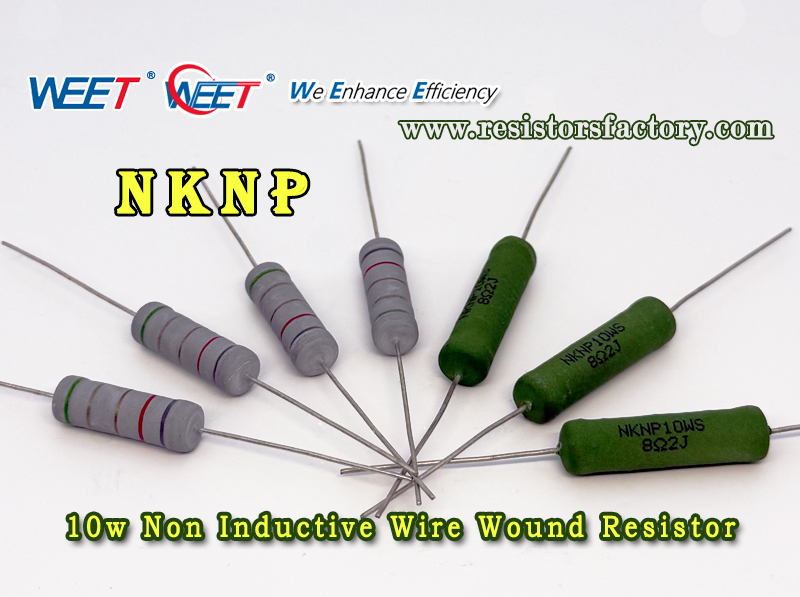
WEET Why You Need A Non-Inductive NKNP Resistor For A Dummy Load?
If resistors are needed for dummy load applications, non-inductive resistors should be the top choice. Why you need a non-inductive resistor for a dummy load?
Because NKNP 10w non inductive wire wound resistor offer distinct advantages in high-frequency or pulse circuit scenarios.
The reasons are as follows:
Avoid inductive interference in high-frequency scenarios
Traditional inductive resistors generate inductive reactance at high frequencies, leading to signal distortion. Non-inductive resistors, however, can offset inductance and maintain stable impedance.
Enhance pulse load capacity
In pulse dummy load scenarios, the inductance of resistors will cause current overshoot, which may damage the resistors. NKNP 10w non inductive wire wound resistor respond to pulse currents more stably and reduce transient voltage fluctuations.
Improve heat dissipation reliability
Dummy load resistors usually operate under high-power conditions. Non-inductive resistors such as NKNP adopt high-thermal-conductivity substrates and heat-resistant insulating coatings, delivering excellent heat dissipation performance.
CONCLUSION
Note: The internal structures of WEET NKNP 10w non inductive wire wound resistor (Max inductance < 1uH) include cross winding and parallel winding.
Most products on the market have a resistance range of 1Ω–15Ω, while the WEET NKNP series has been upgraded to 50Ω.